

Is it bad to sleep with the TV on?
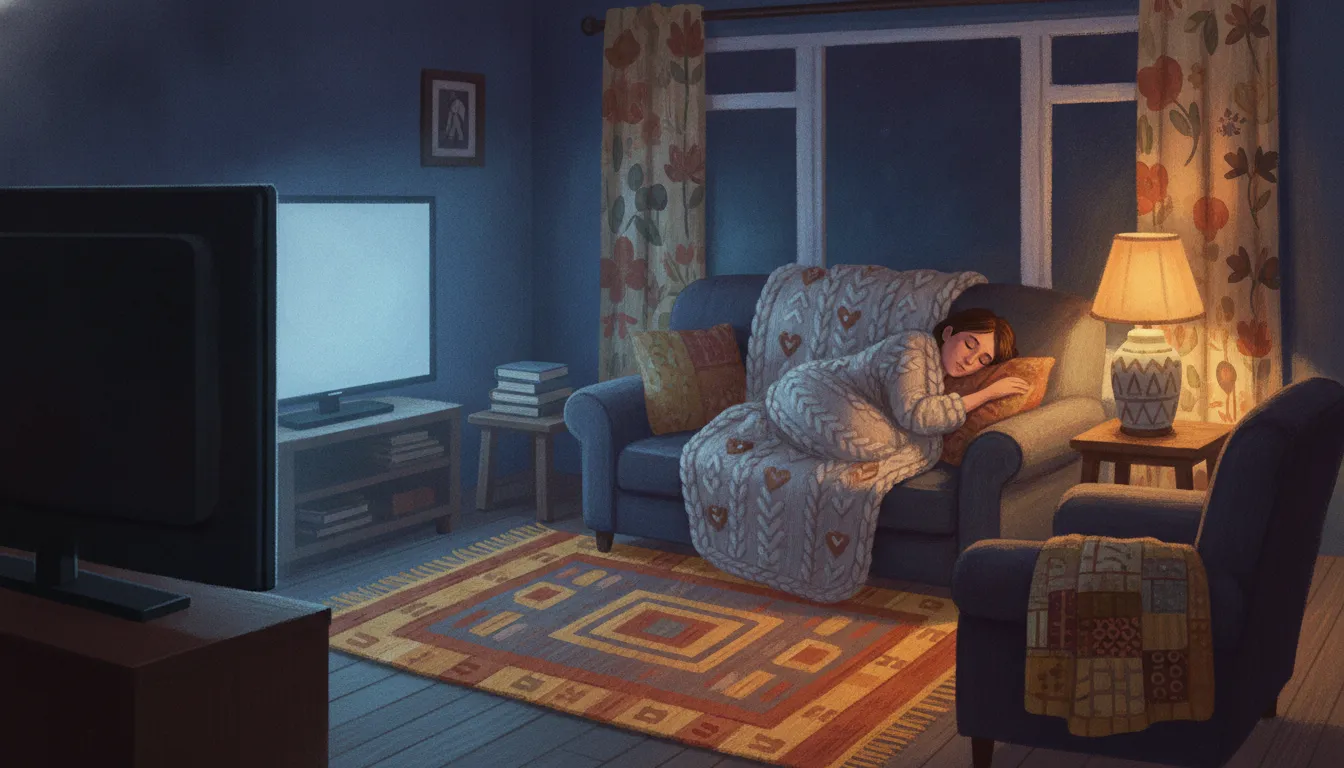
The advice column answer is “stop doing it,” and it is not much use, because the habit persists for a reason that works. Falling asleep with the television on does three separate things at once: it distracts you from your own thoughts, it puts light in the room, and it produces unpredictable jumps in volume. The first is the reason it helps. The other two are the reasons it costs you. The useful move is to separate them rather than to quit.
The part that works
People who take a long time to fall asleep are not lying about why. When researchers tracked arousal across the evening in 15 people with sleep-onset insomnia and 15 normal sleepers, the two groups looked similar earlier in the evening and diverged in the bedroom itself, where the insomnia group was significantly more cognitively aroused and significantly less sleepy (Robertson 2007). The bedroom is where the thinking starts.
Giving that thinking somewhere to go helps, and the effect is specific. Forty-one people with insomnia were given one of three instructions for the pre-sleep period: distract yourself using a particular engaging mental image, distract yourself generally, or nothing. Those given the imagery task dropped off sooner, and reported their unwanted thoughts as both rarer and less upsetting than the group told nothing (Harvey & Payne 2002). General distraction did not show the harm the researchers expected, but it also did not deliver what the specific, absorbing task did.
A television is a general-purpose distraction machine, which is why it half-works. Something with a narrative you can follow with your eyes closed is closer to the thing that was tested.
The volume problem
This is the strongest argument against leaving it running, and it does not depend on any claim about screens.
What pulls a sleeper toward waking is a change in sound level rather than the level itself. In one small sleep-lab study, five people exposed to recorded hospital noise stirred at the same gap between baseline and peak whether or not white noise had been added underneath, 17.7 dB against 17.5 dB, rather than at any particular peak (Stanchina 2005). In pooled polysomnography across 94 sleepers and tens of thousands of noise events, the odds of waking rose roughly 35% for every extra 10 dB of indoor peak level (Basner & McGuire 2018).
A film’s third act is built out of exactly those jumps. So is an autoplay transition from a quiet documentary to a trailer. Worth noting that the old complaint about ad breaks being louder is now partly out of date, since loudness rules require ads to match programming on average, but averages are not what wake you and a gunshot in a quiet scene is still a gunshot in a quiet scene.
The light problem, sized properly
Here we want to be careful, because this is where articles overreach. Nobody has measured how much light a television delivers to a sleeper’s eyes across a dark bedroom, and nobody has paired television light with a sleep or melatonin outcome. What exists is evidence about light in general, and it needs translating rather than quoting.
Evening light is potent at ordinary indoor levels. In 55 young adults, the level that suppressed half of melatonin production was around 25 lux, and 10 lux was enough to delay melatonin onset by 22 minutes, with individual sensitivity varying more than fiftyfold (Phillips 2019). Light during sleep matters too: with 100 lux of overhead light for one night, 20 adults showed higher heart rate, more light sleep, less deep and REM sleep, and reduced insulin sensitivity the next morning, all without any change in melatonin (Mason 2022).
Both of those are much brighter than a television across a room. The most relevant study is dimmer and smaller: 23 healthy young men slept a night with no light and a night with just 5 or 10 lux, and the dim-light nights produced more time awake after falling asleep, more of the lightest sleep stage, and less of the next one (Cho 2016). Real bedrooms, measured in nearly 3,000 people, run a median of about 1 lux (Obayashi 2022), so a lit screen puts you above typical rather than into the range of a lab study.
So: dim light through the night has measurable costs, a television is dim light, and the specific measurement has never been made. Screen timing before bed is a different question with its own evidence, and it concerns the hours before you sleep rather than the hours during.
What the direct evidence says, which is not much
Almost nothing, and you deserve to know that. There is no experiment in adults on sleeping with a television on. The survey evidence pulls in different directions: one study of 816 Norwegians aged 16 to 40 found computers and phones predicted a later lights-out while television, DVDs, consoles, and radio did not, with no difference in insomnia symptoms for any of them (Brunborg 2011). A study of 711 adults found that how much television people watched predicted a later weekend bedtime and little else, with the authors concluding that reducing media use may not belong in adult sleep-hygiene advice (Custers 2012).
The finding that fits everything else here comes from binge viewing. In 423 young adults, binge viewing was associated with worse sleep quality, more fatigue, and more insomnia symptoms, and the whole association ran through cognitive arousal before sleep. Regular television viewing showed no such association (Exelmans 2017). It is not the television. It is being wound up by it.
What to do instead
Keep the distraction, lose the screen and the spikes.
- Switch to audio. Same job, no light, and you can close your eyes. A story you can follow without watching is the closest match to what was tested.
- Set a timer so nothing changes level after you are asleep; where the timer hides on each platform takes half a minute to learn.
- If you keep the TV, cap the volume and use its own sleep timer, and turn off autoplay so the queue cannot escalate.
- Don’t watch something absorbing. The binge finding says the arousal, not the medium, is what costs you.
- If the bed has become a place you do everything except sleep, that pattern has its own fix in stimulus control.
Get Sleepy is the substitute we make: 1,100-plus episodes of slow bedtime stories, new ones most days, narrated by Thomas Jones and a cast of guest narrators, free to stream with ads, with Premium removing the ads and adding hundreds of bonus episodes. Every episode is read by a real person, which we set out in how we make our shows. Whether stories work is a fair question and we answer it without flattering ourselves in do sleep stories work.
Sources: Robertson et al. 2007 · Harvey & Payne 2002 · Stanchina et al. 2005 · Basner & McGuire 2018 · Phillips et al. 2019 · Mason et al. 2022 · Cho et al. 2016 · Obayashi et al. 2022 · Brunborg et al. 2011 · Custers & Van den Bulck 2012 · Exelmans & Van den Bulck 2017. This is general information, not medical advice — persistent insomnia is worth taking to a doctor.
Common questions
- Is it bad to sleep with the TV on?
- Parts of it are. Leaving a television running overnight does three separate things: it distracts you from your own thoughts, which helps; it adds light, which works against you; and it produces sudden changes in volume, which pull you toward waking. Nobody has run a study on the whole habit in adults, so the useful answer is to keep the distraction and drop the other two.
- Why do I need the TV on to fall asleep?
- Usually because it stops you thinking. People who struggle to fall asleep are measurably more cognitively aroused once they are in the bedroom than people who don't, and a television gives that spinning mind somewhere else to go. That is a real mechanism, and it is why the habit is hard to drop with willpower alone.
- Does the light from a TV affect your sleep?
- Probably a little, though nobody has measured a television specifically. One sleep-lab study found that even quite dim light through the night, 5 to 10 lux, increased time awake and shifted sleep stages, though it was small at 23 young men. A TV across a dark room is far dimmer than the room lighting used in most studies, so treat this as a reason to prefer audio rather than as an alarm.
- What should I use instead of the TV to fall asleep?
- Something with the same distraction and none of the light or volume spikes, which usually means audio. A story or a podcast keeps a busy mind occupied while your eyes stay closed, and setting a sleep timer stops it before an episode change wakes you back up.