

How accurate are sleep trackers? And the risk of believing them
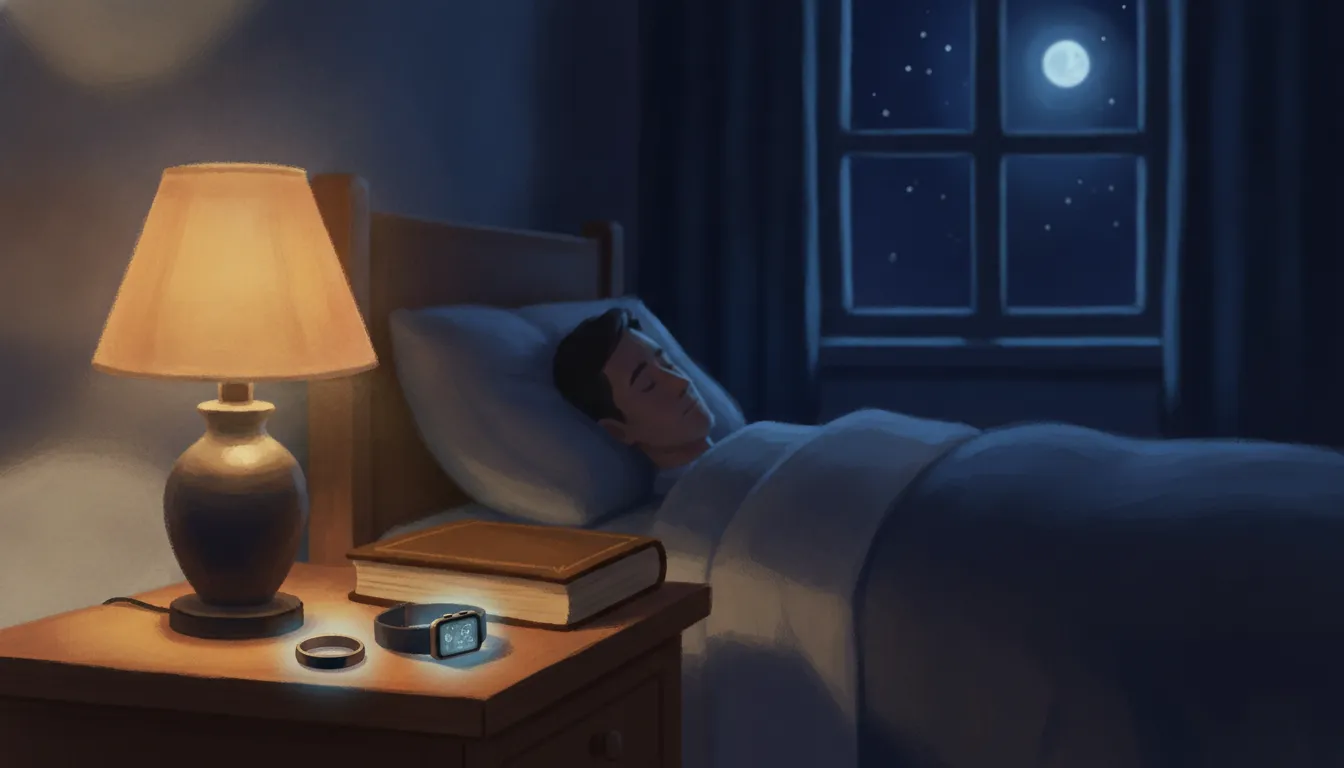
A ring, a watch, or a mat under the mattress will hand you a sleep score every morning, broken into light, deep, and REM. It’s the centerpiece of most sleepmaxxing routines. Two questions are worth asking about it: how accurate is that number, and what does checking it every morning do to you?
What the lab comparison found
Researchers put 34 healthy young adults through overnight polysomnography, the clinical gold standard that reads actual brain activity, while they simultaneously wore seven consumer sleep trackers, four wearable and three not, plus a research actigraph.
The headline result is a mismatch that’s easy to miss.
Sensitivity was high, with all devices at 0.93 or above. When you were asleep, the trackers almost always said so.
Specificity was low to medium, between 0.18 and 0.54. When you were awake, the trackers often said you were asleep anyway. At the bottom of that range a device correctly identified fewer than one in five wake epochs.
And on the part people care about most: “device sleep stage assessments were inconsistent” (Chinoy 2021).
The reason is physical. Nearly all these devices infer sleep from movement and heart rate. Lying still with your eyes closed, wide awake and irritated, looks almost exactly like sleep to a wrist. Separating N2 from N3 from REM is something polysomnography does by reading brain waves, and a device on your finger isn’t reading brain waves.
The researchers’ own conclusion was measured. Several devices performed comparably to or better than research actigraphy for tracking sleep and wake, which is a real improvement. It isn’t the same thing as measuring your sleep architecture.
The part clinicians worry about
In 2017, sleep researchers published a case series describing patients arriving at clinic with self-diagnosed sleep problems based entirely on tracker data. People convinced they weren’t getting enough deep sleep, or that their sleep was too light.
They coined a term for it: orthosomnia. The pattern they describe is a “perfectionistic quest for the ideal sleep”, and the detail that should give anyone pause is that patients often found the tracker data more credible than validated clinical measures (Baron 2017).
The mechanism is straightforward and a little bleak. Insomnia is substantially driven by anxiety about sleep. Give someone a nightly score and you’ve built a machine for generating anxiety about sleep, one that hands them a number to worry about at the moment they’re already worrying.
For a tracker whose specificity is 0.18, “you got 47 minutes of deep sleep” is a confident-looking figure attached to a measurement the device can’t reliably make.
How to use one without it using you
Trackers aren’t useless. They’re better at some jobs than others.
- Trust the trends, not the nights. Averaged over weeks, bedtime and wake-time data are useful. Any single night’s stage breakdown is noise.
- Timing is the reliable output. When you went to bed and when you got up is what these devices measure well, and it’s also what matters most for your circadian rhythm.
- Ignore the stage percentages. Least reliable number on the screen, most likely to worry you.
- Check it in the afternoon, not at 3am. Looking at your score in bed is the exact behavior the orthosomnia paper describes.
- How you feel wins. If you feel rested and the app says you slept badly, the app is wrong. You’re the gold standard here, not the ring.
- Take a break if it’s making you anxious. Dreading the morning score is the signal to stop for a month.
When the number is the problem
The irony of the category is that the people most likely to buy a sleep tracker are the people whose sleep is worst, and anxiety about sleep is the thing most likely to make it worse still.
If you’re lying awake watching your score decay, the useful move is the opposite of measurement: something to occupy your attention that has nothing to do with how you’re sleeping. Sleep stories exist for exactly this, and Get Sleepy is free. For chronic insomnia, CBT-I directly targets the anxiety loop a tracker tends to feed.
Sources: Chinoy et al. 2021 · Baron et al. 2017. This is general information, not medical advice — persistent insomnia is worth taking to a doctor.
Common questions
- How accurate are sleep trackers?
- They are accurate about whether you are asleep and much weaker on whether you are awake. Measured against overnight lab recordings in 34 adults, all seven consumer devices identified sleep at least 93% of the time, while their accuracy on wake ran from 18% to 54%. At the bottom of that range, a device correctly spotted fewer than one in five waking moments, though the researchers noted several devices did as well as or better than a research actigraph at telling sleep from wake.
- Can sleep trackers measure deep sleep and REM?
- Sleep stages are the part they handle worst. The lab comparison described the devices' stage assessments as inconsistent, and telling those stages apart takes a reading of brain activity. Nearly all these devices work from movement and heart rate instead, so a figure like 47 minutes of deep sleep looks precise while resting on a measurement the device cannot reliably make.
- What is orthosomnia?
- It is the term sleep researchers coined in 2017 for an unhealthy fixation on tracker data. Their case series described patients arriving at clinic with sleep problems they had diagnosed from an app, on what the authors called a perfectionistic quest for the ideal sleep, and often finding the tracker more credible than validated clinical measures. Insomnia is substantially driven by anxiety about sleep, so a nightly score can end up generating the worry that keeps people awake.
- Should I stop using my sleep tracker?
- Only if it is making you anxious; dreading the morning score is the signal to take a month off. Otherwise use it for the parts it does well: trends averaged over weeks, plus what time you went to bed and what time you got up, which is also what matters most for your body clock. Ignore the stage percentages, and look at the score in the afternoon instead of at 3am, since checking it in bed is the behavior the orthosomnia paper describes. If you feel rested and the app says you slept badly, the app is wrong.