

Does calming music actually work on dogs?
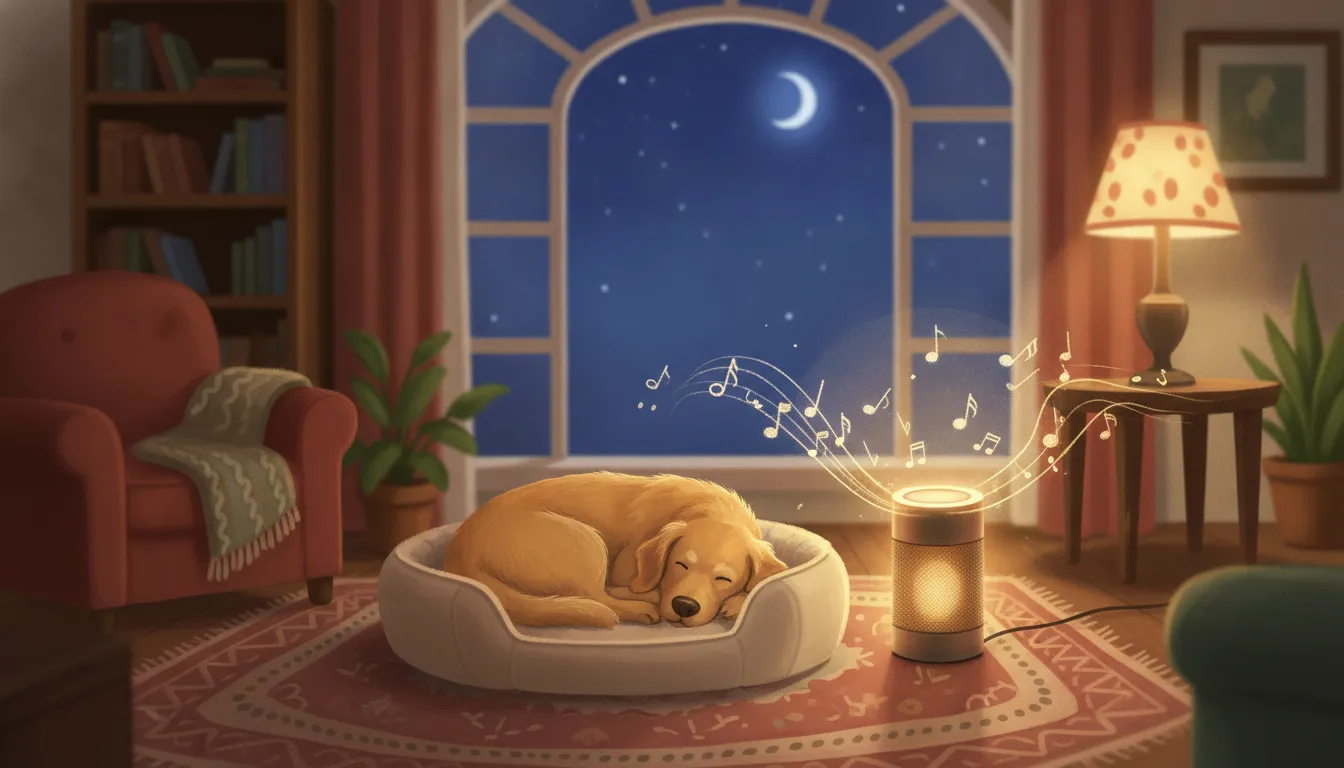
It turns out scientists have been playing music to dogs for two decades — mostly in animal shelters, where stress is high and anything that helps is worth testing. The findings are more interesting than “dogs like Mozart,” and a few of them are directly useful if you’re leaving a nervous dog at home. The human version of the question, including who sound simply doesn’t work on, is in how to sleep with noise you can’t turn off.
Music does something measurable
In a study of 50 dogs at a Scottish SPCA centre, classical music produced heart-rate-variability changes consistent with lower stress, and dogs spent significantly more time lying down and quiet, and less time standing and barking (Bowman 2015). (The human research reads surprisingly similarly; does classical music help you sleep is the people version.) One caveat: salivary cortisol, the other stress measure they took, showed no consistent pattern of change. An earlier shelter study of 50 dogs found the same behavioral pattern, and importantly, it was specific: pop music and recorded human conversation did nothing measurable, so it wasn’t simply “any sound helps” (Wells 2002).
Dogs get bored of it
Here’s the finding that changes how you’d actually use this. In that Scottish study, the calming effect faded within the week. By day seven the dogs’ readings looked like the silent baseline again, and a smaller sub-study in the same paper suggested habituation started as early as the second day.
Variety may be the fix. When researchers rotated 38 dogs through five genres over five days, the heart-rate-variability improvement lasted the whole stretch, and the authors suggested (carefully, since there was no fixed-genre control group to compare against) that habituation may be reduced by increasing variety (Bowman 2017).
Read that one closely, because it was mixed. The clearest heart-rate benefits came from soft rock and reggae, with smaller effects for Motown, pop, and classical. Music had no observable effect on barking at all, and dogs were significantly more likely to bark once it stopped. Strangest of all, urinary cortisol went up during soft rock, the genre that looked best on heart-rate variability. So: don’t loop one playlist forever, but don’t expect music to be a volume knob for stress either.
Heavy metal is a mistake
This one is consistent across studies. Heavy metal caused significantly more barking than any other condition in the 50-dog shelter study, and in a separate study of 117 kenneled dogs, heavy metal tracks were associated with body shaking, a nervousness sign, during 38% to 71% of observations, versus under 3% for classical (Kogan 2012). Your dog is not enjoying Slayer.
Two more useful findings
A human voice may work as well as music. In a study of 31 shelter dogs, an audiobook produced significantly more resting and less anxious vigilance than classical music, pop music, purpose-made dog music, or silence (Brayley & Montrose 2016). If you want to test that at home, The Sleepy Bookshelf is a soft-spoken narrator reading classics for hours, roughly what those researchers were playing. The human evidence on being read to is its own tangle, which do sleep stories work untangles.
Purpose-made “dog relaxation music” hasn’t proven itself. In the 117-dog study, a commercial psychoacoustically-designed dog track was statistically indistinguishable from silence, while plain classical music beat it. Save your money.
The honest limitation
Nearly all of this was done in shelters, kennels, and vet clinics — environments stressful in ways your living room isn’t. When researchers tested pet dogs during short separations from their owners, classical music was only moderately calming, and an audiobook showed no measurable benefit at all (Kinnaird 2022). Sound is not a substitute for training, exercise, or a vet’s help with real separation anxiety.
Cats got their turn too: 20 cats scored lower on stress and handling scales during vet exams with cat-specific music than with silence or classical, though a blood-based stress marker showed no difference (Hampton 2020).
If you want to try it
Deep Sleep Sounds is what a lot of our listeners use for exactly this — 400+ sounds and calm music you can rotate so nothing gets stale, with long play for while you’re out. Your dog has excellent taste.
Sources: Bowman et al. 2015 · Bowman et al. 2017 · Wells et al. 2002 · Kogan et al. 2012 · Brayley & Montrose 2016 · Kinnaird & Wells 2022 · Hampton et al. 2020.
Common questions
- Does music calm dogs down?
- In shelters it does something measurable. Fifty dogs listening to classical music showed heart-rate-variability changes consistent with lower stress and spent more time lying down and quiet, and an earlier 50-dog study found that pop music and recorded human conversation did nothing, so it is not simply that any sound helps. Salivary cortisol showed no consistent pattern in the first of those studies, so the picture is not uniform.
- What music is best for dogs?
- Classical has the most support behind it, and when researchers rotated 38 dogs through five genres, the clearest heart-rate benefits came from soft rock and reggae, with smaller effects for Motown, pop, and classical. Heavy metal is the one to avoid: it produced more barking than any other condition in one shelter study, and body shaking during 38% to 71% of observations in another, against under 3% for classical.
- Should I leave music on for my dog when I go out?
- It is a reasonable thing to try, with two limits. The calming effect faded within a week in the shelter study, with signs of habituation by the second day, so rotating what you play makes more sense than looping one playlist. And when researchers tested pet dogs during short separations from their owners, classical music was only moderately calming, so sound is no substitute for training, exercise, or a vet's help with real separation anxiety.
- Does music made for dogs work?
- It has not proven itself. In a study of 117 kenneled dogs, a commercial dog-relaxation track was statistically indistinguishable from silence, while plain classical music beat it. Save your money.
- Is an audiobook better than music for dogs?
- One study points that way. Thirty-one shelter dogs rested significantly more and showed less anxious vigilance with an audiobook playing than with classical music, pop music, purpose-made dog music, or silence. That did not carry over to pet dogs at home, where an audiobook showed no measurable benefit during short separations from their owners.