

Does white noise help babies sleep? What the research says
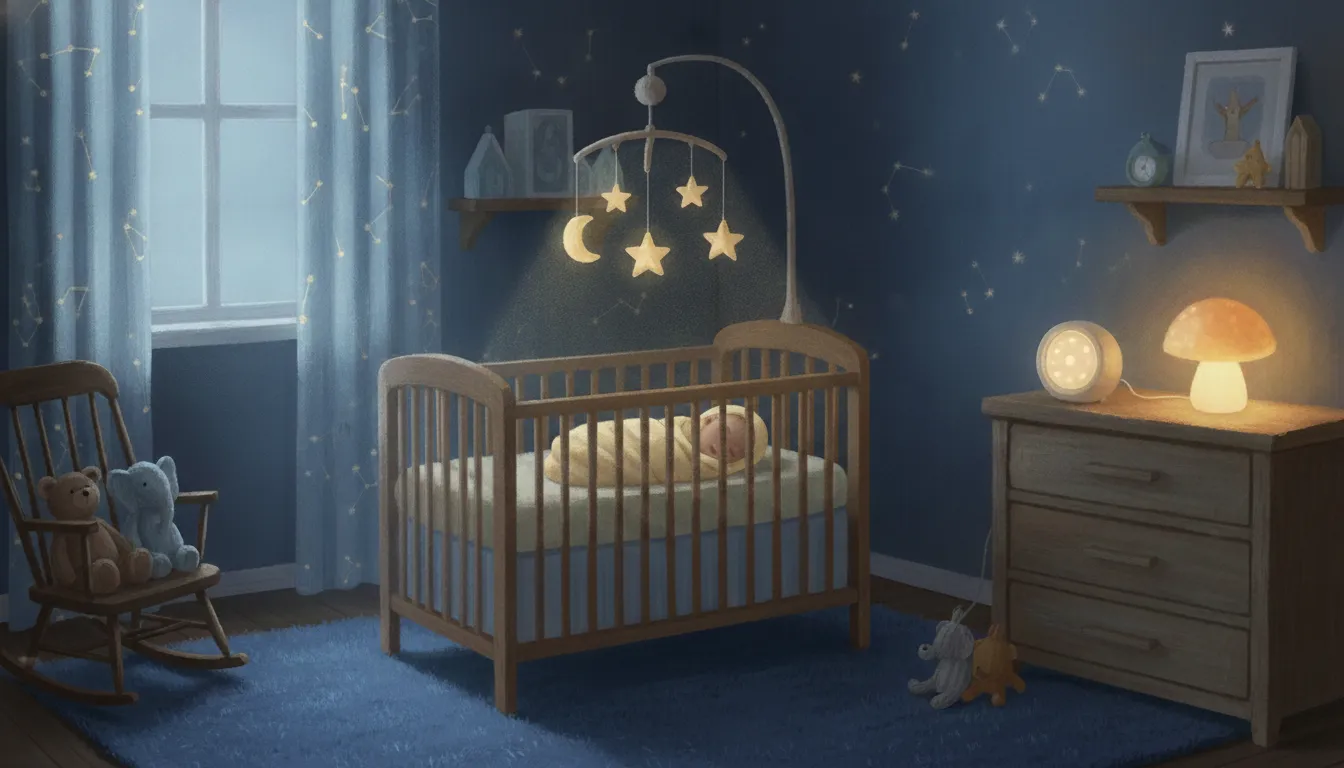
Almost every exhausted parent gets handed this advice: try white noise. It’s one of the few tips that’s both free and plausible. But the evidence behind it is smaller than its reputation, and the safe-use part matters more than most articles admit. Here’s the whole picture. Infants play by stricter rules than adults, and the general case for when sound helps and when it doesn’t is worth reading alongside this.
The study everyone cites
In 1990, researchers randomized 40 newborns, two to seven days old. Sixteen of the 20 babies (80%) hearing white noise fell asleep within five minutes, compared with 5 of 20 (25%) settling on their own (Spencer 1990).
That’s a striking result, and it covers exactly this: 40 days-old newborns, measured over five minutes, more than three decades ago. It tested how quickly babies fell asleep, not whether they stayed asleep, slept longer, or woke less. Nothing in it speaks to a six-month-old, and no study since has established a durable sleep-duration benefit. The broadest review of continuous noise as a sleep aid, across 38 studies and all ages, rated the overall quality of evidence “very low” (Riedy 2021).
So: promising for settling a newborn, oversold as a whole-night solution.
Why rumbly sound seems to work
There’s a nice piece of physics behind the womb comparison. When researchers measured sound inside the human uterus, low frequencies around 125 Hz came through slightly amplified, while higher frequencies were damped by up to 10 dB (Richards 1992). The prenatal soundscape is low, muffled, and rumbly — much closer to a deep whoosh than to a bright hiss. That’s a good argument for choosing deeper sounds over hissy ones. It is not an argument that loud is natural: womb sound reaches a fluid-filled ear through tissue, which is a completely different exposure from airborne noise in a nursery.
The part that deserves more attention than it gets
Sound machines can get louder than people expect. When researchers measured 14 of them at maximum volume, every one exceeded 50 dBA at about a foot away (the limit recommended for infants in hospital nurseries), and three exceeded 85 dBA, loud enough to breach adult workplace limits if it ran all night (Hugh 2014).
That sounds alarming, and it partly is. Distance helps a great deal: those numbers were taken a foot from the machine, and average output fell from about 79 dBA there to 63 dBA at roughly seven feet. But distance alone doesn’t solve it: even at that seven-foot mark, 13 of the 14 machines were still above the 50 dBA nursery limit when turned all the way up. Placement and volume have to do the work together.
The American Academy of Pediatrics’ 2023 noise report says that if sound machines are used, it may be safer to put the device as far from the infant as possible, keep the volume as low as possible, and limit how long it runs, and emphasizes that dose means duration, not just loudness (Balk 2023). There’s a reason for the duration point: in rat pups, constant moderate background noise (not loud enough to harm hearing, just loud enough to mask ordinary sound) delayed normal auditory development (Chang 2003). No study has demonstrated harm from nighttime sound-machine use specifically, but the human evidence is limited and mixed rather than reassuring: a 2024 review of 20 studies found the available human data broadly consistent with those animal results, and recommended capping both intensity and duration on these devices (De Jong 2024).
Practically: across the room, never in or on the crib. Lowest volume that actually works: 50 dBA at the crib is the number to aim at, which is quieter than ordinary conversation and closer to soft rain outside a window than to a running shower. Off once your baby is soundly asleep rather than running all night at volume.
You don’t need to buy a machine to test any of this. A phone or laptop across the room works fine, and our sister site WhiteNoise.com plays white noise free in any browser, with a sleep timer to keep the run time capped.
If you want to try it
Deep Sleep Sounds has a section of deep, rumbly baby-soothing sounds, plus a sleep timer that fades out on its own, the feature that matters most here, since it means the sound ends on schedule without you creeping back in to switch it off. And if the whole household turns out to like the rumble, fan noise is the grown-up version of the same taste.
Sources: Spencer et al. 1990 · Riedy et al. 2021 · Richards et al. 1992 · Hugh et al. 2014 · Balk et al. 2023 · Chang & Merzenich 2003 · De Jong et al. 2024. This is general information, not medical advice — any questions about your own baby’s sleep or hearing are worth taking to your pediatrician.
Common questions
- Does white noise help babies sleep?
- For settling a newborn, the case is promising. In a 1990 trial of 40 babies under a week old, 80% fell asleep within five minutes with white noise playing, against 25% of those left to settle on their own. That study measured only how quickly they dropped off, and no study since has established a lasting benefit for sleep duration; a review of 38 studies of continuous noise across all ages rated the overall quality of evidence very low.
- How loud should a baby's white noise machine be?
- Aim for about 50 decibels at the crib, the level recommended for infants in hospital nurseries. That is quieter than ordinary conversation, closer to soft rain outside a window than to a running shower. Use the lowest volume that does the job, since every one of 14 machines tested at full volume came in above that level from a foot away, and three were loud enough to breach adult workplace limits if left running all night.
- Where should you put a sound machine in a nursery?
- Across the room, as far from the baby as possible, and never in or on the crib. Distance does real work: average output in one test fell from about 79 decibels a foot away to 63 decibels at roughly seven feet. Volume still has to come down with it, because at that seven-foot mark 13 of the 14 machines tested were above the 50-decibel nursery level when turned all the way up.
- Should white noise play all night for a baby?
- Switching it off once your baby is soundly asleep is the safer habit. The American Academy of Pediatrics advises limiting how long a sound machine runs, and treats duration as part of the exposure alongside loudness. No study has demonstrated harm from nighttime sound-machine use specifically, though the human evidence there is limited and mixed rather than reassuring, and a 2024 review of 20 studies recommended capping both intensity and run time. A sleep timer that fades out on its own handles this without you creeping back into the room.