

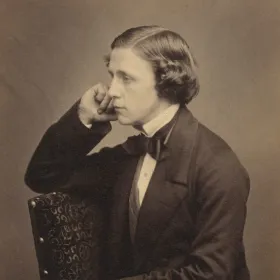
Lewis Carroll
Dream logic on purpose: nonsense that meets the falling-asleep mind halfway.
Lewis Carroll wrote the only classics in this collection that are dreams by design. Alice drowses off, in effect, on page one, and everything after runs on the logic of the half-conscious mind: rooms change size, conversations loop, nobody explains. A listener drifting off does not fight that structure; they join it.
Alice's Adventures in Wonderland, from 1865, is the start, and the Alice book with two readings, Elizabeth Grace's on The Sleepy Bookshelf and Andrew Bond's on Send Me To Sleep. Because the book is a chain of encounters instead of a plot, losing your place costs nothing; the Cheshire Cat will still be grinning wherever you resume.
Through the Looking Glass and What Alice Found There is the mirror side, built on a chess game and stranger than its predecessor. Elizabeth Grace reads it at half speed, which suits a book where time already runs backward at least once. Take Wonderland first; cross the mirror second.